
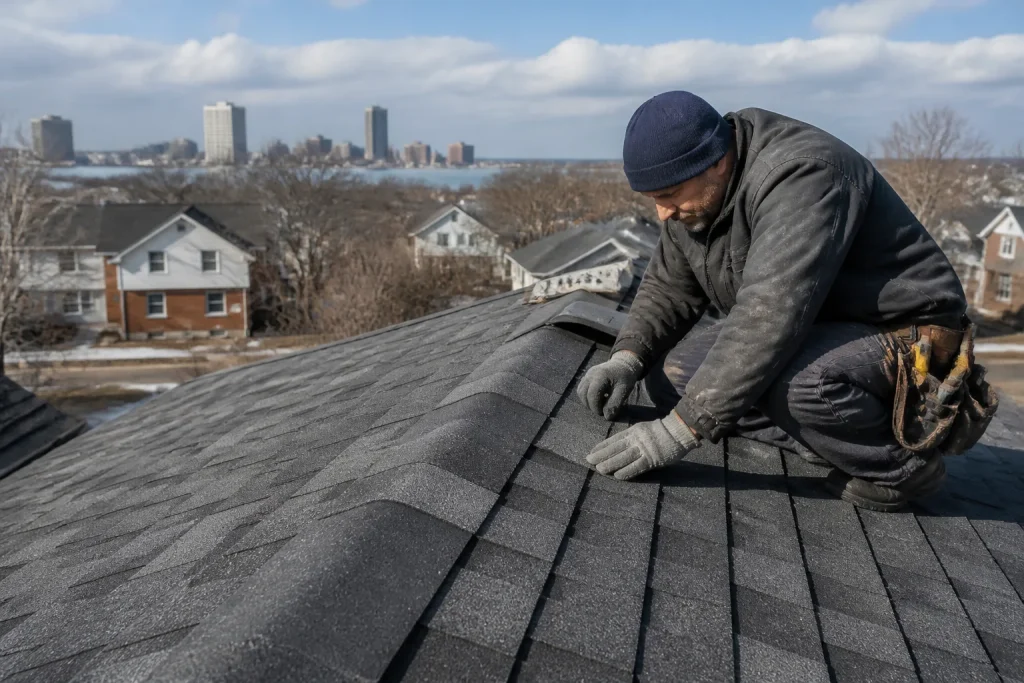
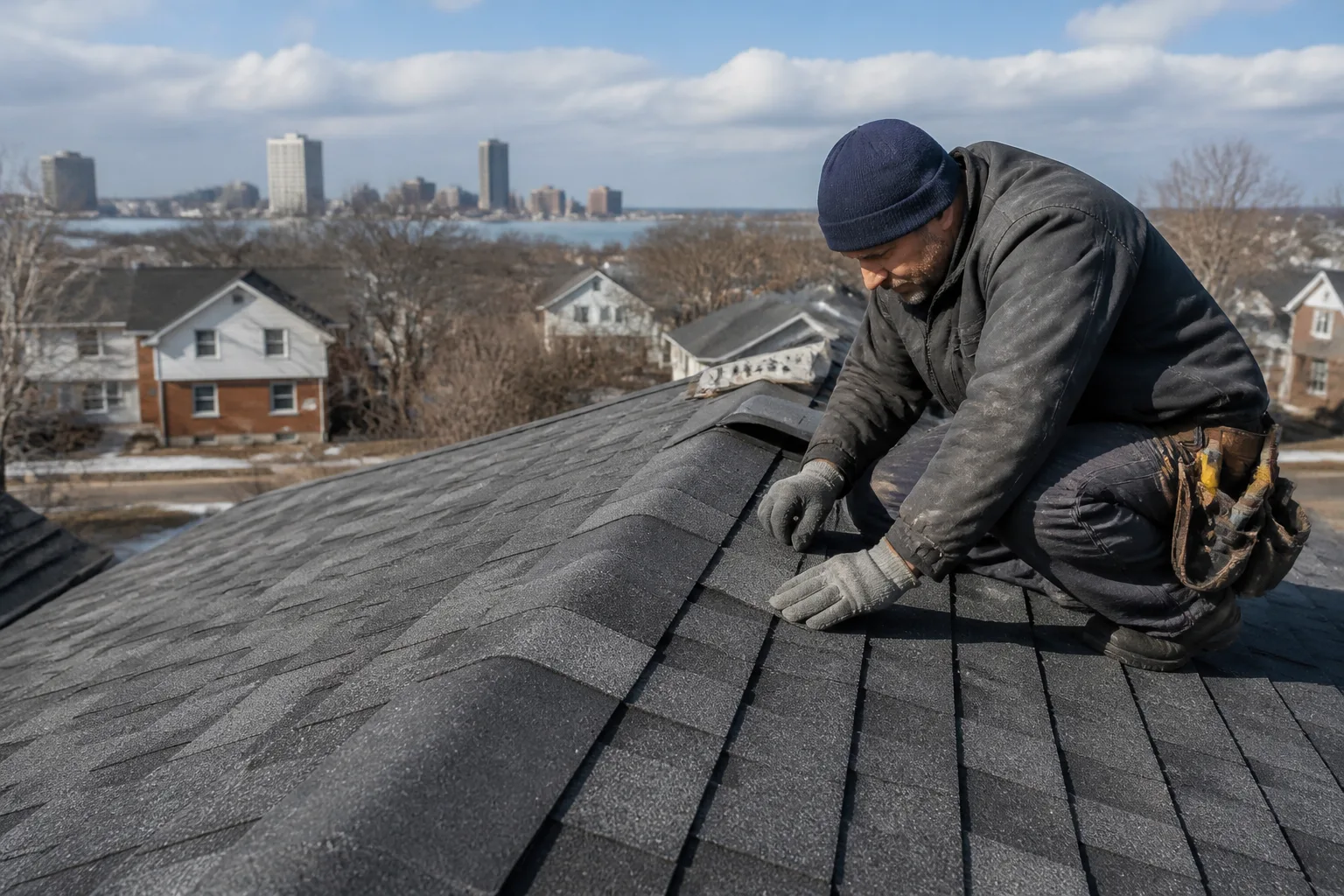
IKO Roof Repair in Buffalo: A Homeowner’s Guide
IKO’s Cambridge line carries a wind warranty up to 130 mph. That coverage can be voided the moment a repair uses a competing manufacturer’s starter strip or an incompatible adhesive, and most homeowners only learn it after the fact. IKO shingles handle Buffalo winters well, but only when repairs respect the brand’s own tolerances on tab alignment, exposure and sealing. This guide covers what an IKO repair actually requires, and what to ask before anyone touches your roof. If you’d rather not sort through it yourself, call (866) 389-4577 and we’ll take a look.
What Makes IKO Shingles Different, and Why It Matters for Repairs
IKO laminate shingles are built as two bonded layers with a pronounced, defined tab pattern. That construction is what makes an IKO repair different from swapping in whatever three-tab or laminate shingle a contractor happens to have on the truck.
Two measurements govern a lasting repair:
- Tab alignment. The new shingle’s tabs have to line up with the existing course geometry. Misalignment throws off the shadow lines and, more importantly, leaves seams sitting closer together than the manufacturer intended.
- Exposure matching. Exposure is the visible height of each shingle course. Get it wrong by even a fraction and the courses above won’t lay flat, which invites wind lift and water tracking sideways under the shingle.
There’s a third factor specific to Western New York: sealant strip chemistry. IKO’s sealant is formulated to activate under sun and pressure. Mix in a different brand’s adhesive and the strips may bond unevenly, or not at all on a cold repair. That’s how a small fix becomes a lifted shingle after the first big blow off Lake Erie. In our experience, the repairs that fail early in Buffalo are almost always material-mismatch failures, not workmanship on the tear-off itself.
Which IKO Lines You’ll Find on Buffalo Homes, by Era
Buffalo’s housing stock runs from late-1800s frame houses to mid-century bungalows to newer builds on the outer rings, and the IKO product on each roof tends to follow the decade it went on.
Older laminate installations
Roofs shingled roughly fifteen to twenty-five years ago often carry an earlier IKO laminate. These are the most repair-friendly roofs when the mat is still sound, because the tabs are still distinct enough to match. Once the mat starts to check and crack, though, patching becomes a losing game: each repair disturbs neighbors already near the end of their life.
Cambridge and similar mid-era laminates
Cambridge is one of the most common architectural shingles on Buffalo-area roofs. Its heavier profile handles snow load and freeze-thaw cycles better than a flat three-tab, and repairs are straightforward when a contractor carries matching stock.
Newer premium laminates
More recent installs are usually still under their material coverage, which is exactly why matching matters. Putting a different brand’s shingle on a young IKO roof can create a warranty question on the whole slope.
Age changes the repair-or-replace line. A single damaged area on a ten-year-old IKO roof is a repair. Widespread brittleness on a twenty-year-old one usually isn’t. That’s why we inspect first and quote second: when repair is right, we repair, and only recommend roof replacement when the shingle field can no longer take a patch.
What a Warranty-Compliant IKO Repair Actually Requires
An IKO-compatible repair means matching the shingle line and color, using the correct underlayment and starter, and sealing with an adhesive the manufacturer accepts for that product. Walk through any repair and the details are unglamorous but decisive:
- Matching shingle product. Same line, same profile, same color lot where possible. A close color is not the same as a matching product.
- Correct starter course. Starter strips are manufacturer-specific. Using a different brand’s starter under an IKO field can void wind coverage on the eave course.
- Approved sealant. Hand-sealing lifted tabs with a generic roof cement is common and often the wrong call. The right approach is the manufacturer’s approved adhesive or a full replacement of the affected shingle.
- Proper fastening. Nail placement and count per shingle are specified by the manufacturer, and high nailing is one of the quiet killers of wind coverage.
Here’s the part homeowners rarely hear: many common substitutions void coverage. Non-matching starter, off-brand adhesive, cement smeared over a torn tab instead of replacing the shingle. None of it shows from the ground. All of it can be cited if a claim ever comes up. If you’re weighing options, our page on roof repair covers how we approach a repair decision.
Granule Loss: Cosmetic Weathering or Binder Failure?
Some granule loss is normal on any asphalt shingle, and a handful of granules in the gutter after a storm proves nothing. The question is whether you’re seeing surface wear or the shingle’s asphalt binder breaking down. A few things to check, from the ground or a window, never by walking the roof:
- Pattern. Scattered, even granule loss across a slope is usually weathering. Bald patches concentrated in the valleys or at the bottom edge of a course suggest the mat is failing there.
- Texture. Run a hand along an accessible edge (from a ladder, feet on the ground). Shingles that feel gritty and pliable are wearing normally. Ones that feel brittle and crack at a bend are near the end.
- Granule dams. Piles of granules collecting at the base of a downspout or in a gutter valley point to active shedding, not scattered wear.
- Shadow lines. Soft or disappearing shadow lines on an IKO laminate signal the tabs are flattening, which is a binder problem, not a cosmetic one.
Binder failure on an IKO roof usually means section replacement, not a spot patch. The shingle can’t hold a seal anymore, and sealing a failing tab just delays the inevitable by one season. This is where an honest inspection earns its keep.
When to Call a Pro
You can check granule loss and inspect a ceiling stain without leaving the ground. Climbing a roof to check tab adhesion, nail placement or flashing is a different matter: steep pitches, wet shingles and height make it a job for trained technicians, and a fall is a real risk. Same story with anything near a chimney or skylight, where the flashing detail is the whole repair. If you see active leaking, missing shingles or a sagging area, stop and call (866) 389-4577.
Related services in Buffalo: We handle roof repair, roof replacement, and standalone inspections across the area. If you’re comparing Tidewater Roof Repair to other contractors, our full range on Buffalo homes is a fair place to start.
Questions to Ask a Contractor About IKO Work
General shingle experience is not the same as IKO experience. The brand’s tolerances, sealant behavior and warranty language are specific, and a few direct questions will sort out who actually knows the product.
- Which IKO line is on my roof, and how do you confirm it? A contractor who can’t tell an IKO laminate from another brand’s laminate isn’t ready to repair one.
- Do you stock matching IKO materials, or order them for the job? Matching stock means the repair isn’t held up waiting on a delivery that may not exist.
- How do you handle the starter strip on a repair? There’s a correct answer, and it involves the manufacturer’s product, not a substitute.
- What adhesive do you use to re-seal tabs? If the answer is generic roof cement, ask why.
- Is my roof still under manufacturer coverage, and will this repair affect it? A contractor who thinks about warranty before touching the roof is worth keeping.
- Can I see the inspection findings before the estimate? You should get a diagnosis first, then a price.
One reason we carry seven leading brands, including IKO, CertainTeed and Owens Corning, is that a genuine IKO repair sometimes means working with the homeowner’s existing product while recommending a compatible one elsewhere. You’re not limited to what one brand makes, or to a single supplier’s opinion.
The Bottom Line
IKO makes a shingle that suits Buffalo, and a repair on one is straightforward when the material match is right. The risk isn’t the shingle. It’s a contractor who treats an IKO roof like any other and reaches for the wrong starter, the wrong adhesive, or the wrong exposure. Age and binder condition decide whether a spot repair holds or whether a section needs to come off. Confirm the product line, get the inspection findings in hand, and ask anyone you hire what they’ll use to seal it.
If you’re in Buffalo and want an honest look at what your IKO roof actually needs, Tidewater Roof Repair offers free estimates and inspection-first service. We look before we quote, and we handle the repair and any replacement with the same crew. Call (866) 389-4577 to schedule your free estimate.
Frequently Asked Questions
Yes. A warranty-compliant IKO repair uses the matching IKO shingle, the correct starter strip and manufacturer-approved adhesive. Substituting another brand’s starter or a generic roof cement can void wind and sealant coverage on the affected area, even if the repair looks fine from the ground.
Scattered, even granule loss is normal weathering. Bald patches concentrated in valleys or at the bottom of a course, brittle shingles that crack at a bend, and piles of granules at the downspout point to binder failure. That’s a section replacement, not a spot patch. Call (866) 389-4577 for an inspection to confirm.
Not without risk. Mixing a different brand’s shingle or starter with an IKO field creates exposure and sealant mismatch problems, and it can raise warranty questions on the whole slope. A contractor who carries multiple brands can match the existing IKO product and save the mixed materials for a different job.
It depends on the mat’s condition, not the calendar. A sound IKO roof with isolated damage is usually a good repair candidate. A brittle, shedding roof where the tabs no longer seal is a replacement conversation. An inspection tells you which one you’re looking at before you spend anything. Call (866) 389-4577 for a free estimate.
Written by the team at Tidewater Roof Repair, serving Buffalo since 2011.
Need Roofing Help?
Call Tidewater Roof Repair - licensed & insured, with free written estimates in Buffalo.
(866) 389-4577