
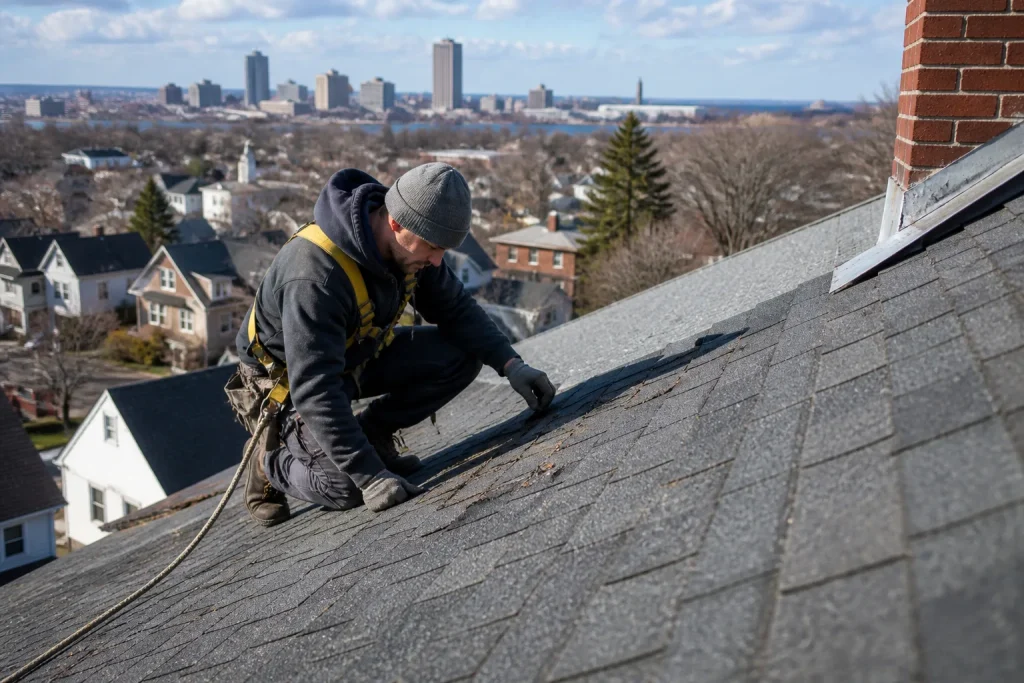
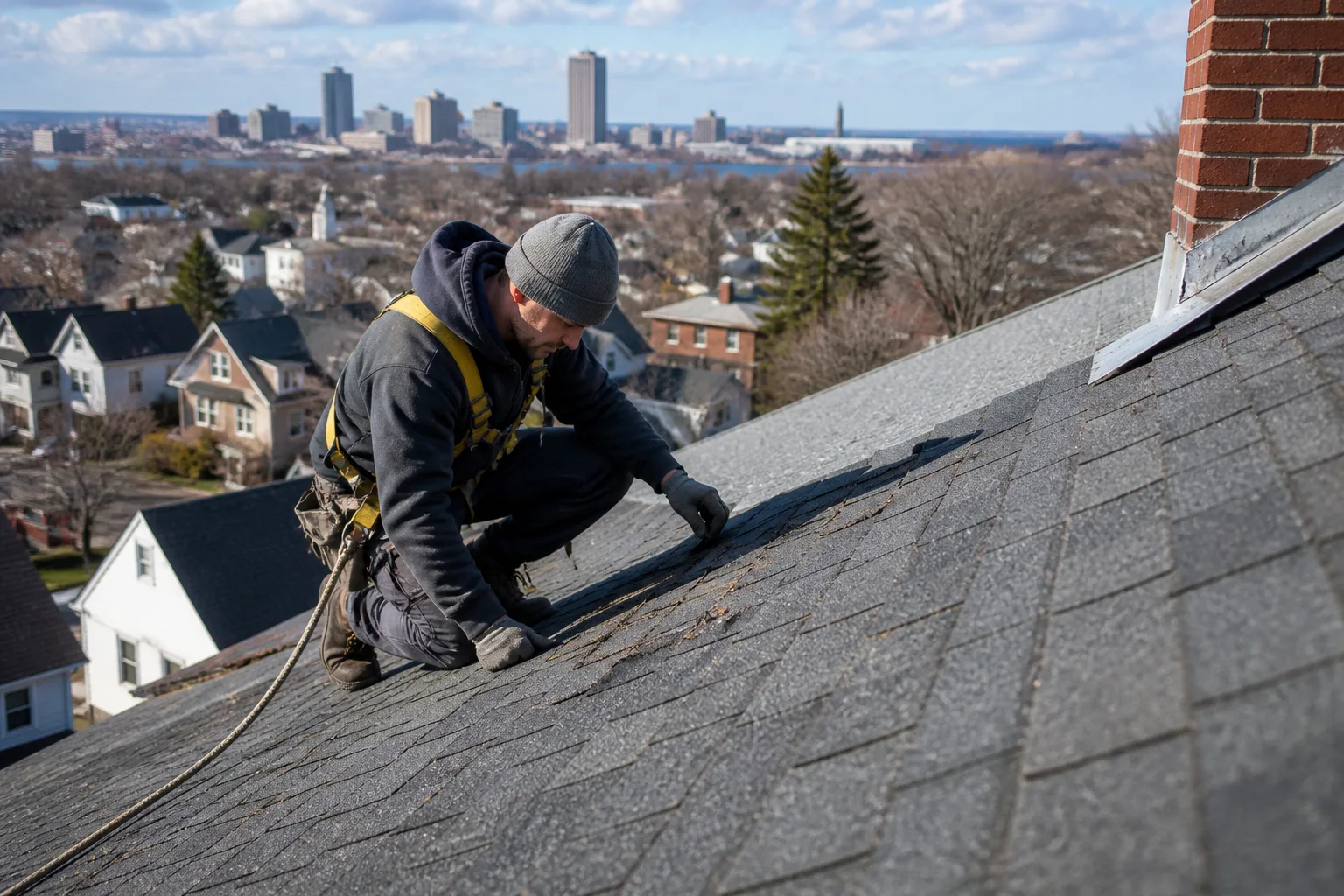
Roof Repair Cost Guide: What Buffalo Homeowners Pay in 2026
A national home improvement site will tell you roof repair costs $150 to $400. A Buffalo homeowner who treats that estimate as accurate is usually the same one paying for the same repair again two winters later. In 2026, most common roof repairs in Buffalo run between $475 and $2,400, depending on what actually failed and how much of the roof has to come apart to fix it correctly. If you’d rather have someone look before you commit to a number, call (866) 389-4577.
The gap between the national figure and what we quote isn’t padding. It’s the ice-and-water shield, the pitched-roof labor, the disposal, and the difference between a repair that survives a Buffalo February and one that doesn’t. This guide walks through the real 2026 numbers and the reasoning behind them.
Key Takeaways
- Common Buffalo roof repairs in 2026 typically land between $475 and $2,400.
- Ice-and-water shield requirements add material cost to almost every repair here.
- A $400 patch and a $1,200 repair can look identical from the ground. The difference is usually underlayment, flashing detail, and whether the repair is meant to last.
- Low-ball estimates often skip the permit line, the underlayment spec, or the material brand. All three are worth asking about.
- Repair makes sense when the roof has years left. Partial replacement makes sense when failures cluster on one slope.
What do common Buffalo roof repairs actually cost in 2026?
Here are the typical 2026 ranges for the repairs we see most often around Buffalo. Each figure includes labor and material. The written estimate sets the final price, and these ranges are estimates, not quotes.
- Ice dam damage repair: $650 to $2,400. Labor runs roughly 55 to 65 percent of that. Ice dam damage usually involves torn shingles, saturated decking, and sometimes interior water staining that reveals itself later.
- Wind-lifted shingle repair: $475 to $1,100. Material is a smaller share here, unless a whole slope lifted. The bulk of the cost is careful removal of broken shingles without damaging the ones around them, plus matching the replacement shingles to what you have.
- Failed flashing repair (chimney, wall, skylight): $525 to $1,400. Flashing failures are the quiet ones. They hide behind siding and stucco and leak for a season before anyone notices. Proper flashing work is slow, detailed labor.
- Valley repair: $700 to $1,900. Valleys take the most water on any roof. If the valley metal or the woven underlayment has failed, that’s a bigger job than a single-shingle fix.
In every case, the material side of the bill is smaller than homeowners expect, and the labor side is larger. That ratio matters when you’re comparing estimates. A quote that’s dramatically cheaper is almost always cheaper on labor, and labor is where repairs are won or lost.
Why do Buffalo roof repair estimates run higher than national averages?
Three things push Buffalo repair costs above what a national pricing site will tell you: ice-and-water shield, pitch, and disposal.
Ice-and-water shield expectations. Roofs in this climate need ice-and-water shield along the eaves, in valleys, and around penetrations. Most cities require a permit for roofing work, and here the local building department expects that shield where water backs up. It’s a material cost most national guides never account for, and it’s not optional if the repair is going to hold through a lake-effect winter.
Pitch premiums. Many Buffalo roofs, especially on older homes, are steeper than the national average. Steep-pitch work means more time, more safety gear, and more careful staging. That’s real labor, not markup. A roof that takes an extra half day to work safely costs more to fix, and it should.
Disposal under Erie County regulations. Torn-off shingles are heavy and have to be hauled and disposed of properly. Disposal is a line item on every honest estimate, and its absence is a red flag.
The result: a repair that a national guide prices at $300 might land at $650 here, and that’s before you account for whether the repair actually lasts. If you want the full picture of roof repair in this climate, it’s worth reading beyond the cost tables.
What separates a $400 repair from a $1,200 repair for what looks like the same missing shingle?
From the ground, two repairs can look identical. On the roof, they’re not the same job at all. The $400 version usually means new shingles nailed over whatever’s underneath. The $1,200 version means removing the failed shingles, inspecting the underlayment and decking, replacing what’s compromised, installing new ice-and-water shield where required, and matching the replacement material so the repair is weather-tight and blends with the rest of the roof.
The $400 repair might hold for a season. The $1,200 repair is built to hold against what comes next. Which is the economically sound choice? It depends on the age of the roof. On a roof with fifteen years left, the cheaper repair rarely makes sense, because you’ll pay for the same spot twice. On a roof that’s already near the end of its life, paying for a thorough repair may be money you’d rather put toward roof replacement instead.
Red flags in low-ball estimates:
- No permit line item. Most cities require one for roofing work.
- No mention of underlayment or ice-and-water shield.
- A lump-sum quote with no material specifications.
- No brand named. Reputable contractors will tell you whether they’re using GAF, CertainTeed, or another line, and why.
We work with seven leading brands, including GAF, Atlas, and Tamko, so material choice is driven by what the roof needs and what you want to spend, not by what one supplier happens to stock. You’re not limited to what one brand makes.
Repair or partial replacement: which is the better investment?
This is the question that decides most Buffalo roofing budgets, and it’s answerable. A rough cost-per-year framework helps.
- Estimate the repair cost. Say it’s $850.
- Estimate the remaining life of the roof. If it has ten years left and the repair buys you those ten years, that’s $85 per year.
- Compare to replacement. A full replacement amortized over a new roof’s lifespan often runs lower per year than a series of repairs on a failing roof.
When repair is the clear winner: isolated damage on a roof with plenty of life left, a single flashing failure, a handful of lifted shingles after a storm. When partial replacement is the winner: failures clustering on one slope, repeated leaks in the same area, or damage that spans most of one plane of the roof.
The honest answer is that you can’t know which side you’re on without an inspection. In our experience, the inspection-first approach saves homeowners money because it produces a diagnosis before a dollar figure. We look before we quote. That’s why Roof Inspection is a standalone service at our company, not a sales call in disguise.
When to call a pro: any time the failure involves flashing, valleys, or the decking underneath. Those are the repairs where a wrong call gets expensive fast, and where the roof’s real structure is exposed.
Related services in Buffalo: if you need a full assessment before deciding, start with a Tidewater Roof Repair inspection. For homeowners weighing a full new roof, roof replacement covers the replacement side in detail.
What should Buffalo homeowners ask before signing a repair estimate?
Ask four questions. The answers tell you most of what you need to know.
- Is the permit included? It should be a line item, not a surprise later.
- What underlayment and ice-and-water shield are you using? If the answer is vague, the estimate is vague.
- What brand and product line? A contractor who works with multiple manufacturers can tell you why a particular shingle fits your roof and budget.
- What’s the scope if you open it up and find more? Ice dam damage in particular can reveal decking problems once the shingles come off. You want to know how change orders get handled before work starts, not after.
A repair and a patch are different products, and a good estimate tells you which one you’re buying. When you’re comparing numbers around Buffalo, compare scope, not just the bottom line.
The Bottom Line
Most Buffalo roof repairs in 2026 land between $475 and $2,400, and the reasoning behind each number is as important as the number itself. Ice-and-water shield, steep-pitch labor, and proper disposal all add cost, and they’re all what make a repair last. A low estimate that skips them is often the most expensive choice in the long run. If you’re in Buffalo and need help, Tidewater Roof Repair offers free estimates. Call (866) 389-4577 to schedule yours.
Frequently Asked Questions
Most common repairs run $475 to $2,400, depending on the type of damage. Ice dam damage and valley repairs sit at the higher end, while wind-lifted shingles and smaller flashing fixes are often lower. Call (866) 389-4577 for an exact quote. Estimates are free.
Ice-and-water shield expectations, steep-pitch labor premiums, and disposal under Erie County regulations all add cost that national guides don’t account for. Those costs are part of doing the repair correctly in this climate. Call (866) 389-4577 to talk through your specific roof.
Not without your approval. A written, line-item estimate should specify material, labor, permit, and disposal up front. If the crew finds additional damage once shingles come off, you should hear about it before any change order is signed. Call (866) 389-4577 to schedule a free estimate.
Repair makes sense when the damage is isolated and the roof has years left. Partial or full replacement makes sense when failures cluster or the roof is near the end of its life. The best way to decide is an inspection first. Call (866) 389-4577 to book one.
Written by the team at Tidewater Roof Repair, serving Buffalo since 2011.
Need Roofing Help?
Call Tidewater Roof Repair - licensed & insured, with free written estimates in Buffalo.
(866) 389-4577